
Best Vans for Window Cleaners
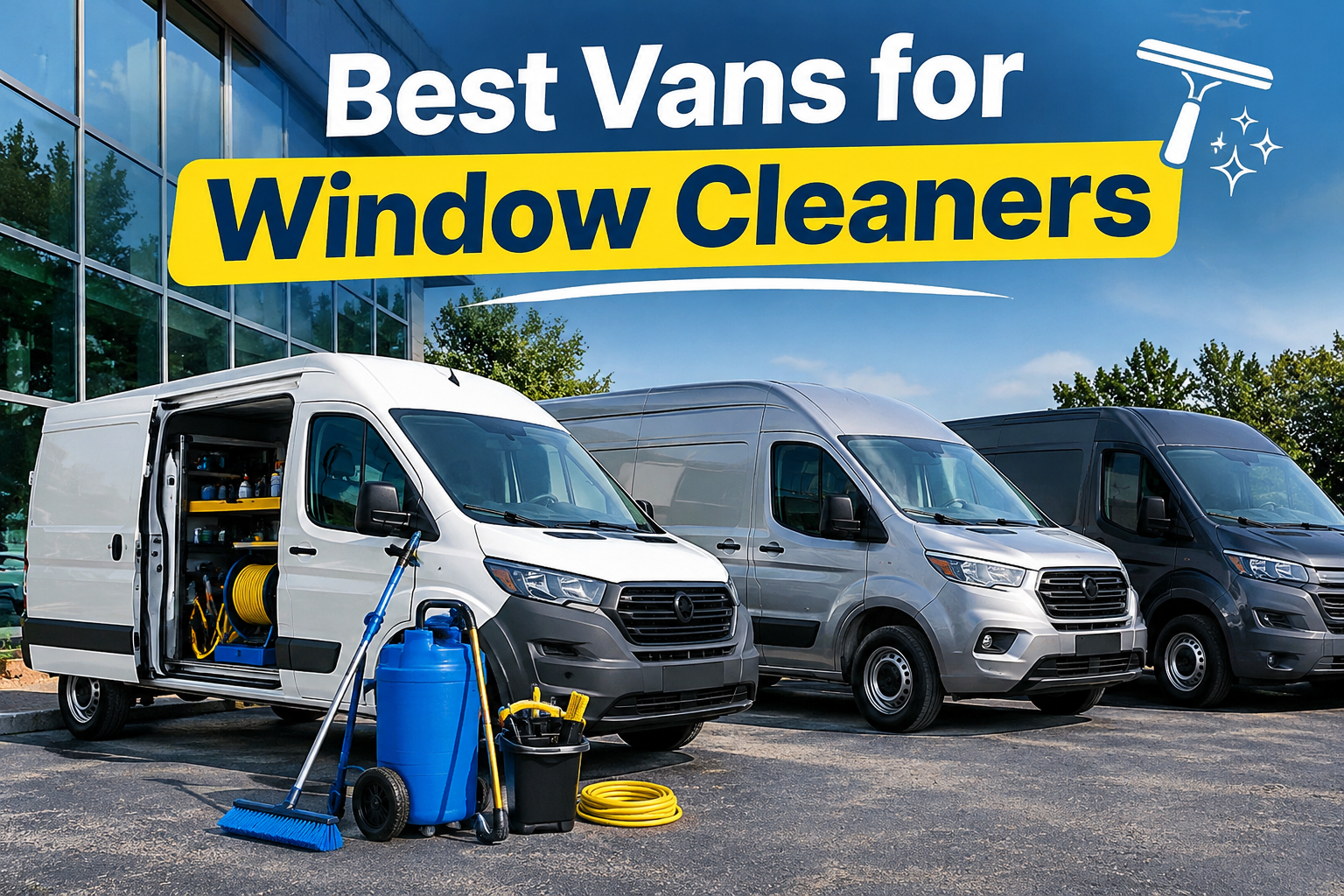
Choosing a van for your window cleaning business isn't simply about finding something reliable with enough room for a water tank. It's about investing in a vehicle that can handle the daily demands of your work, carry your equipment safely, keep running costs manageable and support your business as it grows.
Get the decision right, and your van becomes one of your most valuable business assets. Get it wrong, and you could find yourself dealing with insufficient payload, cramped storage, expensive repairs or a vehicle that no longer meets your needs after just a year or two.
Whether you're starting a residential round, upgrading your existing setup or expanding into commercial window cleaning, this guide will help you identify the most suitable vans for the job.
The Quick Answer: Which Van Should You Choose?
The ideal window cleaning van depends on your water tank capacity, equipment requirements, budget and whether you work alone or with a team.
Here's a quick breakdown of the strongest options.
| Van Model | Best Suited For | Main Advantage |
|---|---|---|
| Ford Transit Custom | Established window cleaning businesses | Excellent balance of load space, payload options and practicality |
| Renault Trafic | Growing businesses and larger water-fed pole systems | Spacious interior and versatile configurations |
| Vauxhall Vivaro | Everyday residential and commercial cleaning | Practical load area and a wide choice of used vehicles |
| Citroën Berlingo | Solo window cleaners and smaller setups | Compact dimensions and economical operation |
| Peugeot Partner | New businesses and residential rounds | Easy manoeuvrability and manageable running costs |
| Ford Transit Connect | Urban window cleaning businesses | Compact design with useful equipment storage |
| Volkswagen Transporter | Established operators seeking a versatile van | Strong all-round usability and multiple configurations |
| Mercedes-Benz Vito | Professional teams carrying substantial equipment | Comfortable driving experience and flexible load space |
Our recommendation: For many established window cleaning businesses, the Ford Transit Custom is an excellent starting point. However, a smaller Citroën Berlingo or Peugeot Partner may be more economical for a solo operator with modest equipment requirements.
Crucially, no van should be selected based on its model name alone. The specific vehicle's payload rating must accommodate your full water tank, cleaning equipment, driver, passengers and any additional cargo.
Five Things to Know Before Buying
-
Water is heavy. A 500-litre tank holds approximately 500kg of water before accounting for the tank itself, mounting frame or other equipment.
-
Payload matters more than appearance. A spacious van isn't necessarily capable of safely carrying a large water-fed pole system.
-
Smaller vans can be ideal for residential rounds. Compact vehicles are easier to park and often cheaper to operate.
-
Think about future growth. If you're planning to employ another cleaner or add gutter cleaning services, additional load space and payload could prove invaluable.
-
Always check the exact vehicle specification. Payload capacities vary considerably between model years, engines, body lengths and trim levels.
The right vehicle should make your working day easier, not introduce unnecessary complications.
What Makes a Good Window Cleaning Van?
A good window cleaner van needs to do considerably more than transport you between customers.
Unlike a typical delivery vehicle, a window cleaning business van may carry hundreds of litres of water, specialist pumps, filtration equipment, hose reels, batteries, poles and other accessories.
That combination creates some unique requirements.
1. Sufficient Payload Capacity
Payload is arguably the single most important factor when choosing a van for window cleaning.
Your van's payload capacity is the maximum additional weight it can legally carry within its permitted gross vehicle weight.
This includes more than just your water tank.
You need to account for:
-
Water carried in your storage tank
-
The empty tank and its mounting frame
-
Water-fed poles and other cleaning equipment
-
Pumps, controllers and filtration systems
-
Hose reels and associated fittings
-
Leisure batteries and electrical equipment
-
The driver and any passengers, where not already included in the quoted mass
-
Ladders, gutter vacuums and additional tools
-
Personal belongings and other cargo
Manufacturers may quote payload figures using different assumptions about occupants, fuel and vehicle equipment. Always check how the figure has been calculated.
Example: A 500-litre water-fed pole setup
| Item | Illustrative Weight |
|---|---|
| 500 litres of water | 500kg |
| Empty tank and mounting frame | 55kg |
| Pump, filtration and plumbing | 25kg |
| Hose reel and hose | 25kg |
| Battery and electrical equipment | 25kg |
| Water-fed poles and accessories | 15kg |
| Driver | 85kg |
| Additional equipment | 35kg |
| Total additional load | 765kg |
These figures are illustrative estimates, not specifications for a particular installation. Actual equipment weights vary, and the vehicle's quoted payload may already account for some items.
A van with a quoted payload of 800kg might appear suitable on paper. However, once you consider optional equipment, passengers, axle limits and the actual weight of the installation, the available margin could be uncomfortably small.
This is why a high payload van can be a much better long-term investment than a cheaper vehicle operating close to its legal limits.
Important: Never assume that a van can safely carry a particular tank size simply because the tank physically fits inside. Confirm its remaining payload, axle weights and secure mounting arrangements before installation.
2. Enough Space for Your Water-Fed Pole System
Modern window cleaning businesses increasingly depend on efficient working methods, particularly when managing growing residential rounds and commercial contracts.
For operators using pure water window cleaning, the van effectively becomes a mobile workstation.
A typical van mounted window cleaning system may include:
-
A baffled water storage tank
-
A 12V water pump
-
A digital pump controller
-
A water purification system
-
DI resin vessels or reverse osmosis filtration
-
An electric or manual hose reel
-
A leisure battery
-
A carbon fibre water-fed pole
-
Storage for brushes, connectors and spare parts
Some businesses also install hot water window cleaning systems, booster pumps or additional hose reels for two-person operation.
Your chosen van needs enough space to accommodate this equipment without creating an awkward or unsafe working environment.
Consider where each component will sit before purchasing.
Can you reach the hose reel without climbing inside? Is the pump accessible for maintenance? Can you remove the filtration equipment without dismantling half the installation?
These seemingly small details make a substantial difference when you're completing multiple jobs every day.
3. Reliability and Affordable Running Costs
A van that regularly breaks down doesn't just cost money to repair.
It can also mean cancelled appointments, disrupted cleaning rounds and dissatisfied customers.
For window cleaners who depend on consistent work, reliability is essential.
When comparing vehicles, consider:
-
Maintenance and servicing costs
-
Availability of replacement parts
-
Fuel economy
-
Insurance premiums
-
Vehicle age and mileage
-
Service history
-
Tyre and brake replacement costs
-
Expected annual mileage
-
Suitability for repeated short journeys
A well-maintained used van may provide better value than a newer vehicle with a questionable history.
Equally, the cheapest van to purchase isn't always the cheapest to own.
An affordable vehicle requiring frequent repairs could become significantly more expensive over several years than a more reliable alternative.
4. Easy Access and Practical Storage
Think about how often you open your van during a typical working day.
For many window cleaners, the answer is dozens of times.
That's why loading access and van interior layout deserve serious consideration.
A sliding side door can provide convenient access to tools, while rear doors allow hose reels and water-fed pole equipment to be positioned near the back of the vehicle.
Useful features include:
-
Wide-opening rear doors
-
Sliding side access
-
A secure bulkhead
-
Durable, water-resistant flooring
-
Dedicated van racking
-
Protected electrical components
-
Convenient hose reel positioning
-
Secure storage for expensive equipment
A carefully planned window cleaning van setup can reduce unnecessary movement, minimise equipment damage and make everyday work noticeably more efficient.
Best Small Vans for Window Cleaning
Small vans are often overlooked by people planning a professional window cleaning business.
That's a mistake.
For a solo cleaner working primarily on residential properties, a compact panel van can offer an excellent combination of practicality, fuel efficiency and affordability.
They're particularly useful for operators covering towns, housing estates and busy residential streets where parking space is limited.
However, their smaller size generally means less flexibility for large water tanks or substantial additional equipment.
Here are three options worth considering.
1. Citroën Berlingo: A Practical Choice for Solo Window Cleaners
The Citroën Berlingo is a popular compact commercial vehicle and a sensible option for window cleaners who don't require a large installation.
Its manageable dimensions make it particularly attractive for residential work.
Why consider the Berlingo?
-
Compact enough for narrow streets and restricted parking
-
Generally economical to operate
-
Useful load space for smaller cleaning setups
-
Wide availability on the used van market
-
Convenient access through sliding and rear doors
-
Suitable for operators who prioritise manoeuvrability
For a one man window cleaning van setup, a Berlingo can be particularly effective when paired with a modest water tank and carefully organised equipment.
What Size Water Tank Can a Berlingo Carry?
This depends entirely on the specific vehicle.
A 350-litre water tank contains approximately 350kg of water. A 400-litre tank contains approximately 400kg.
Once you add the mounting frame, pumps, hose reel, battery, tools and driver, the total load increases substantially.
Some Berlingo variants offer greater payload capacity than others, so it's essential to verify the exact specification before deciding on a tank.
A 500-litre tank should never be assumed suitable without a full payload and axle-weight assessment.
Best for: Solo window cleaners, smaller residential rounds and businesses using compact water-fed pole systems.
Potential drawback: Limited flexibility if you later need a larger tank, additional equipment or space for a second operator.
2. Peugeot Partner: Compact, Economical and Versatile
The Peugeot Partner is another strong contender for anyone searching for the best small van for window cleaning.
Like the Berlingo, it offers practical commercial vehicle features without the size and running costs associated with many medium vans.
For window cleaners just starting out, that can be a major advantage.
A Partner may be particularly appealing if you're building a customer base gradually and want to avoid committing too much capital to your vehicle.
Why the Peugeot Partner Works Well
Its compact footprint makes residential parking straightforward, while the load area can accommodate a thoughtfully designed cleaning setup.
Depending on the variant and available payload, you may be able to install a smaller water tank alongside essential equipment such as a pump, controller, hose reel and water-fed pole.
The key is to keep the installation proportionate to the vehicle.
Avoid filling every available space with equipment simply because it fits.
You still need adequate payload, safe weight distribution and convenient access for maintenance.
Best for: New window cleaning businesses, solo operators and cleaners working on established residential rounds.
Potential drawback: Larger water-fed pole systems and additional services may quickly exceed the practical capacity of some variants.
3. Ford Transit Connect: A Compact Van with Useful Working Space
The Ford Transit Connect offers another appealing option for window cleaners who want a manageable vehicle without sacrificing everyday practicality.
It sits comfortably within the compact commercial van category and is well suited to businesses operating in built-up areas.
For cleaners working across several nearby locations, ease of driving and parking can be just as important as outright cargo volume.
A compact van that saves time on every stop can make a real difference over the course of a busy week.
What Makes the Transit Connect Worth Considering?
The Transit Connect offers:
-
Practical cargo space for compact cleaning installations
-
Convenient access to stored equipment
-
A manageable size for residential work
-
A choice of configurations across different model generations
-
Potentially lower operating costs than larger vans
Its suitability for a van mounted window cleaning system depends on the exact model and payload rating.
For smaller setups, it can provide an effective balance between equipment storage and daily usability.
However, operators planning a substantial water tank, gutter vacuum, pressure washer or second hose reel may benefit from moving into the medium van category.
Best for: Residential window cleaners wanting a compact, practical vehicle with organised equipment storage.
Potential drawback: Limited expansion capacity compared with larger commercial vans.
Small Van Comparison: Which Is Right for You?
| Feature | Citroën Berlingo | Peugeot Partner | Ford Transit Connect |
|---|---|---|---|
| Residential parking | Excellent | Excellent | Excellent |
| Compact water-fed pole setup | Suitable with verified payload | Suitable with verified payload | Suitable with verified payload |
| Large water tank installation | Specification dependent | Specification dependent | Specification dependent |
| Solo operator suitability | Excellent | Excellent | Excellent |
| Two-person setup | Requires careful planning | Requires careful planning | Requires careful planning |
| Additional equipment storage | Limited | Limited | Limited |
| Used market appeal | Strong option | Strong option | Strong option |
All three can make excellent working vehicles, provided the installation is matched to the specific van's carrying capacity.
The takeaway: If you're running a relatively compact residential round, don't automatically spend more on a larger van. A smaller, well-organised vehicle may be everything you need.
But if your plans involve a 500-litre or 650-litre tank, a two-person cleaning team or substantial additional equipment, it's worth considering the next size up.
Best Medium Vans for Window Cleaners
For many established window cleaning businesses, a medium-sized van offers the ideal balance between carrying capacity, working space and everyday practicality.
While compact vans are excellent for smaller residential rounds, their limitations become more apparent as your business grows.
A larger water tank, additional hose reel, gutter vacuum or second employee can quickly make a small van feel restrictive.
That's where medium commercial vans come into their own.
Vehicles such as the Ford Transit Custom, Renault Trafic and Vauxhall Vivaro provide greater flexibility for professional water-fed pole installations, while remaining manageable enough for residential streets and town-centre work.
They're particularly attractive to operators who want a vehicle capable of supporting their business for several years.
4. Ford Transit Custom: One of the Best All-Round Window Cleaning Vans
The Ford Transit Custom is an excellent starting point for anyone looking for a versatile, professional window cleaning vehicle.
It's large enough to accommodate substantial equipment, yet generally more manageable than a full-sized Transit.
For established operators, that combination is difficult to ignore.
Whether you're carrying a water-fed pole system, multiple hose reels or equipment for additional exterior cleaning services, the Transit Custom offers useful flexibility.
Why Is the Ford Transit Custom Popular with Window Cleaners?
One of its biggest advantages is the range of configurations available.
Depending on the model year and specification, buyers can choose between different body lengths, engines, gross vehicle weights and equipment levels.
That means you can select a vehicle that better matches your intended installation rather than trying to make your equipment fit an unsuitable van.
Other advantages include:
-
Generous cargo space for professional cleaning equipment
-
Availability of short wheelbase and longer body configurations
-
Practical access through rear and sliding side doors
-
Room for organised van racking and equipment storage
-
Wide availability of used vehicles
-
Suitable configurations for one-person and two-person working
-
Strong potential for accommodating additional exterior cleaning equipment
For a growing business, these features can make the Transit Custom a particularly sensible investment.
Can You Fit a 500-Litre Water Tank in a Transit Custom?
A 500-litre water tank is a common consideration for window cleaners upgrading from a smaller vehicle.
The Ford Transit Custom may accommodate this type of installation, but suitability depends on the exact van's payload, axle ratings and the weight and positioning of the complete system.
Remember, the water alone weighs approximately 500kg.
Add the tank, mounting frame, pumps, batteries, hose reels, tools and occupants, and the overall load becomes considerably heavier.
A correctly specified Transit Custom can be a practical choice for a 500-litre setup, provided the complete installation has been professionally assessed.
The same principle applies to a 650-litre water tank.
Although the physical load space may be sufficient, not every Transit Custom variant has the necessary remaining payload.
Our advice: Choose the Transit Custom based on its verified carrying capacity, not simply its engine size, body length or appearance. A higher-payload specification may be far more valuable to your business than additional cosmetic features.
Short Wheelbase or Long Wheelbase?
A short wheelbase van is often sufficient for a straightforward water-fed pole setup.
It's generally easier to park and manoeuvre, making it particularly appealing for residential rounds.
A longer-bodied Transit Custom provides additional cargo length, which can be useful if you carry:
-
Multiple water-fed poles
-
Two hose reels
-
A gutter vacuum
-
A pressure washer
-
Additional filtration equipment
-
Ladders and specialist tools
-
Spare parts and maintenance supplies
However, a longer van doesn't automatically offer a higher payload.
In some configurations, additional vehicle weight can actually reduce the amount of equipment you're permitted to carry.
Best for: Established window cleaning businesses, professional water-fed pole systems and operators planning to expand.
Potential drawback: Higher purchase and operating costs than compact vans, with payload varying significantly between specifications.
5. Renault Trafic: A Spacious and Practical Choice
The Renault Trafic deserves serious consideration if you're looking for a medium van with a useful combination of load space, comfort and versatility.
It's particularly appealing to window cleaners who spend long days travelling between jobs and need a practical vehicle for carrying substantial equipment.
The Trafic is available in different lengths and configurations, allowing businesses to select a vehicle suited to their working requirements.
For a professional window cleaning van conversion, that flexibility is valuable.
What Makes the Renault Trafic Suitable for Window Cleaning?
The Trafic's main attraction is its practical cargo area.
A well-designed installation can accommodate a water tank, pump system, hose reel and filtration equipment while leaving space for other essential tools.
Depending on the configuration, there's also potential to accommodate equipment for additional services.
Key advantages include:
-
Spacious and versatile load area
-
Multiple body configurations
-
Convenient access to equipment
-
Suitable options for larger water-fed pole installations
-
Practical driving position for regular daily use
-
Availability on the second-hand commercial van market
-
Potential for a two-person window cleaning setup
For operators moving from a compact van, the additional working space can make a noticeable difference.
Rather than stacking equipment wherever it fits, you can create dedicated storage areas that keep everything accessible.
Is the Renault Trafic Suitable for a 650-Litre Water Tank?
Potentially, yes, but only where the specific vehicle's payload and axle ratings permit it.
A 650-litre tank contains approximately 650kg of water.
Once the tank, frame, pumps, hose reels, batteries and occupants are included, the overall load could approach or exceed the payload capacity of some configurations.
This makes careful vehicle selection essential.
If you're considering a 650-litre water tank van, calculate the full working weight before purchasing the vehicle.
You should also consider where the tank will be mounted.
The position of a heavy water tank affects vehicle weight distribution and individual axle loading, so the installation must be assessed rather than simply positioned wherever there's enough floor space.
Best for: Growing window cleaning businesses, larger water-fed pole installations and operators requiring flexible equipment storage.
Potential drawback: Certain configurations may not provide enough remaining payload for the largest installations, despite their spacious interiors.
6. Vauxhall Vivaro: A Strong Option for Everyday Professional Use
The Vauxhall Vivaro is another excellent candidate for window cleaners looking to upgrade their vehicle.
It offers the practicality expected from a medium commercial van, with configurations suitable for a wide range of business requirements.
For many operators, the Vivaro provides a useful middle ground between a compact panel van and a larger commercial vehicle.
It's particularly worth considering if you're searching the used market for an affordable window cleaning van.
Why Choose a Vauxhall Vivaro?
The Vivaro combines practical load space with manageable dimensions.
That makes it suitable for businesses covering residential properties, commercial premises or a mixture of both.
Depending on the exact vehicle, advantages may include:
-
Useful payload options
-
Practical cargo dimensions
-
Sliding side door access
-
Space for a professionally installed water-fed pole system
-
Availability of different body lengths
-
Suitable configurations for two-person teams
-
A broad choice of used vehicles
One important consideration is that the Vivaro has changed substantially across different generations.
Older vehicles and newer models may have different dimensions, engines, payload ratings and mechanical components.
You should therefore compare individual vehicles rather than assuming every Vivaro offers the same capabilities.
Is the Vivaro Better Than the Transit Custom?
Neither van is automatically better.
The right choice depends on your intended equipment, budget and the specification of the vehicles available.
For example, a higher-payload Vivaro with a documented service history could be a more sensible purchase than a lower-payload Transit Custom in poor condition.
Equally, a well-maintained Transit Custom with a suitable installation layout may offer better long-term value for your particular business.
Consider the following:
| Factor | Ford Transit Custom | Vauxhall Vivaro |
|---|---|---|
| Professional water-fed pole installations | Strong option | Strong option |
| Residential window cleaning | Very suitable | Very suitable |
| Two-person operation | Configuration dependent | Configuration dependent |
| Used vehicle availability | Broad choice | Broad choice |
| Large tank suitability | Payload dependent | Payload dependent |
| Additional equipment storage | Good | Good |
| Best overall choice | Depends on specification | Depends on specification |
Best for: Established residential cleaners, mixed commercial work and operators seeking a practical medium van.
Potential drawback: Significant differences between model generations make specification checks particularly important.
7. Volkswagen Transporter: A Versatile Premium Alternative
The Volkswagen Transporter is worth considering for window cleaners seeking a practical medium-sized van with a professional appearance and flexible cargo space.
It's often viewed as a premium alternative to other commercial vans in its class.
However, paying more for a vehicle doesn't necessarily make it better suited to window cleaning.
What matters is whether the particular Transporter provides sufficient payload and space for your equipment.
Why Consider the Volkswagen Transporter?
Depending on its generation and specification, the Transporter offers:
-
Practical load space for water-fed pole equipment
-
Different body lengths and configurations
-
Comfortable driving characteristics
-
Useful storage possibilities
-
Suitable options for professional van conversions
-
A choice of used vehicles across different price points
For window cleaners who cover substantial daily mileage, driving comfort may be an important consideration.
But don't allow comfort or appearance to distract from the essentials.
A fully equipped van needs to remain within its gross vehicle weight and axle limits.
If you're choosing between a Transporter and a less expensive alternative, compare their actual payload ratings, service histories, insurance costs and suitability for your planned installation.
Best for: Established operators seeking a versatile medium van and willing to consider a higher purchase budget.
Potential drawback: Purchase and maintenance costs can be higher than some competing vehicles.
Medium Van Comparison: Which Offers the Best Overall Package?
If you're choosing between the most popular medium vans for window cleaners, the following comparison provides a useful starting point.
| Van | Main Strength | Ideal Business Type | Key Consideration |
|---|---|---|---|
| Ford Transit Custom | Versatility and equipment storage | Established or expanding business | Check exact payload specification |
| Renault Trafic | Spacious cargo area | Growing business with larger equipment | Confirm loaded axle weights |
| Vauxhall Vivaro | Practicality and used market choice | Residential and commercial cleaning | Compare model generations |
| Volkswagen Transporter | Versatility and driving comfort | Established professional operator | Consider total ownership costs |
| Peugeot Expert | Practical medium-sized layout | Mixed residential and commercial rounds | Verify individual vehicle capacity |
| Citroën Dispatch | Flexible load space | Professional water-fed pole operations | Check tank and equipment weights |
| Toyota Proace | Practical commercial vehicle configuration | Growing cleaning businesses | Compare payload by variant |
| Mercedes-Benz Vito | Comfortable working vehicle | Established teams | Consider purchase and servicing costs |
There isn't a universal winner.
For many window cleaners, the Ford Transit Custom, Renault Trafic and Vauxhall Vivaro should be near the top of the shortlist.
However, the best medium van for window cleaners is ultimately the one that safely accommodates your equipment while remaining affordable to purchase, maintain and operate.
Best Large Vans for Window Cleaning Businesses
Not every window cleaner needs a large van.
In fact, purchasing a vehicle that's substantially bigger than necessary can increase your running costs without providing any meaningful benefit.
However, larger commercial vans become attractive when your business requires more equipment, additional storage or a specialised working setup.
This is particularly relevant for companies offering multiple exterior cleaning services.
A business combining window cleaning with gutter clearing, pressure washing and other maintenance work may need considerably more cargo space than a solo residential cleaner.
Large vans can also provide room for more elaborate storage systems and additional equipment.
The important distinction is that greater load volume doesn't always mean greater legal carrying capacity.
8. Ford Transit: A Practical Option for Expanding Businesses
The full-sized Ford Transit is a logical option for window cleaning companies that have outgrown medium vans.
With a wide range of body sizes and configurations available, it can provide substantial space for specialist equipment.
Depending on the model, a Transit may accommodate:
-
A larger baffled water tank
-
Multiple hose reels
-
Two-person water-fed pole equipment
-
Gutter vacuum systems
-
Pressure washing equipment
-
Additional water purification components
-
Organised storage and van racking
-
Ladders and other specialist tools
The extra cargo area can be particularly useful when equipment needs to remain permanently installed.
However, buyers should pay close attention to gross vehicle weight.
Some larger Transit configurations exceed 3.5 tonnes maximum authorised mass, which can introduce different driving licence and operating requirements.
Best for: Expanding exterior cleaning companies and businesses carrying substantial equipment.
Potential drawback: Higher running costs, larger dimensions and potentially more complex vehicle requirements.
9. Peugeot Boxer and Citroën Relay: Space for Specialist Setups
The Peugeot Boxer and Citroën Relay are both worth considering for businesses requiring a substantial load area.
Their larger panel van configurations can provide useful space for equipment storage and specialist conversions.
For example, a business offering both window cleaning and gutter cleaning may need room for a water-fed pole system alongside a gutter vacuum, poles, hoses and additional tools.
A larger van can make that arrangement more practical.
The Boxer and Relay are particularly interesting when cargo volume and internal layout are major priorities.
However, their suitability depends on the exact vehicle's payload.
A large body, heavy conversion and substantial water tank can quickly consume the available carrying capacity.
Best for: Multi-service exterior cleaning businesses and specialist van conversions.
Potential drawback: Larger vehicles can be less convenient for parking and manoeuvring on residential streets.
10. Mercedes-Benz Sprinter: For Larger Professional Operations
The Mercedes-Benz Sprinter is another option for businesses that need substantial equipment capacity and a larger working area.
It's available in numerous configurations, including vehicles with different lengths, roof heights and gross weight ratings.
This makes it worth considering for more specialised commercial window cleaning operations.
A high roof van may offer additional storage possibilities, although extra interior height isn't always necessary for a conventional water-fed pole installation.
The main advantage is flexibility.
You may be able to design a more elaborate equipment layout with separate storage areas for different cleaning services.
But remember, a larger van can mean higher fuel costs, more expensive maintenance and greater difficulty parking.
Best for: Larger cleaning businesses, multi-service operators and specialist commercial setups.
Potential drawback: Size, purchase cost and operating expenses may be excessive for ordinary residential rounds.
When Is a Large Van Worth the Investment?
A large commercial van becomes more appealing when the additional capacity serves a genuine business purpose.
For example:
-
You're operating a two-person cleaning team.
-
You carry equipment for several exterior cleaning services.
-
Your existing vehicle is consistently short of usable storage space.
-
You need a specialised equipment installation.
-
Your commercial contracts require additional tools or supplies.
-
You have verified that the larger vehicle offers sufficient payload for your intended setup.
If none of these apply, a medium van may be the more economical choice.
Remember: The objective isn't to buy the biggest van you can afford. It's to buy the smallest practical vehicle that safely meets your current requirements while allowing sensible room for future growth.
How Much Payload Do Window Cleaners Actually Need?
Now that we've compared the main vehicle options, it's worth examining the factor that should influence almost every purchasing decision: payload.
This is where many window cleaning van recommendations become misleading.
A manufacturer may advertise an impressive cargo area, but that doesn't tell you how much weight the vehicle can legally carry.
For window cleaners, that distinction is critical.
Understanding Gross Vehicle Weight and Payload
Every commercial van has a maximum permitted loaded weight.
This is commonly referred to as its gross vehicle weight (GVW) or maximum authorised mass (MAM).
Payload is the amount of additional weight the vehicle can carry once its relevant unladen or kerb weight has been accounted for.
In simplified terms:
Available payload = Maximum permitted vehicle weight − Vehicle weight before loading
However, the precise calculation depends on how the manufacturer defines the vehicle's weight.
Some published figures include an allowance for the driver or fuel, while others use different assumptions.
Always confirm the specification for the individual vehicle.
How Much Does a Water Tank Weigh?
Water weight is straightforward to estimate.
One litre of water weighs approximately one kilogram.
| Water Tank Capacity | Approximate Water Weight |
|---|---|
| 250 litres | 250kg |
| 350 litres | 350kg |
| 400 litres | 400kg |
| 500 litres | 500kg |
| 650 litres | 650kg |
| 800 litres | 800kg |
| 1,000 litres | 1,000kg |
These figures represent the water alone.
They do not include the tank, mounting frame, plumbing, pumps, filtration equipment or other items.
A 500 litre water tank van therefore needs considerably more than 500kg of usable payload to operate safely when fully equipped.
Likewise, a 650 litre water tank van requires a substantial carrying capacity once the entire installation is included.
Why Axle Weight Limits Matter
Even if your fully loaded van is below its maximum permitted gross weight, it could still exceed an individual axle limit.
This can happen when a heavy tank or other equipment is positioned incorrectly.
For example, installing a large water tank towards the rear of a van can place a substantial load on the rear axle.
The precise effect depends on the vehicle's wheelbase, tank position and other equipment.
That's why vehicle weight distribution should be considered during the design of any professional installation.
A properly secured tank, appropriate mounting frame and carefully planned equipment layout are essential.
After installation, checking the vehicle at a suitable weighbridge can help confirm its actual loaded weight and axle loads.
How Much Payload Should You Allow?
There is no single payload figure suitable for every window cleaning business.
Your requirements depend on:
-
The amount of water you carry.
-
The weight of the complete cleaning system.
-
The number of occupants.
-
Additional tools and accessories.
-
The weight of any permanent van conversion.
-
Whether you plan to add equipment later.
As a general purchasing principle, choose a vehicle with a comfortable margin above your calculated working load.
Don't plan an installation that depends on every component weighing exactly what you estimated.
Equipment changes, additional passengers and unexpected cargo can all increase the vehicle's working weight.
A van with sufficient spare payload is generally a better investment than one operating permanently at its maximum permitted capacity.
Choosing the Right Water Tank Size for Your Window Cleaning Van
Once you've chosen a suitable van, the next major decision is how much water you need to carry.
It's tempting to assume that a bigger tank is always better. After all, more water means fewer interruptions during your working day.
But there's a trade-off.
A larger water tank increases the weight of your installation, potentially reduces fuel efficiency and takes up valuable cargo space. It may also limit the number of passengers or additional tools you can safely carry.
The best water tank capacity depends on your daily workload, the efficiency of your equipment and how easily you can refill.
350-Litre Water Tank: Ideal for Smaller Residential Rounds
A 350-litre water tank can be a practical starting point for solo window cleaners operating relatively compact residential rounds.
It's particularly appealing to businesses using smaller vans, provided the vehicle has sufficient payload.
Advantages include:
-
Lower water weight than larger installations
-
More room for other equipment
-
Potential compatibility with suitably specified compact vans
-
Reduced need for a large commercial vehicle
-
Practical capacity for some part-time or smaller cleaning rounds
The main limitation is water availability.
If you're cleaning numerous properties throughout the day, particularly those with large glazed areas, you may need to refill more frequently.
A smaller tank can work extremely well when your daily water consumption is predictable.
400-Litre Water Tank: A Practical Middle Ground
A 400-litre water tank offers a modest increase in capacity without the additional weight of a 500-litre installation.
For window cleaners moving from a backpack or trolley system to a van mounted window cleaning system, it can represent a sensible compromise.
It may suit operators who want enough water for a substantial residential round while keeping their vehicle relatively compact.
However, an extra 50 litres compared with a 350-litre tank also means approximately 50kg of additional water weight.
That matters when you're working with limited payload.
500-Litre Water Tank: A Popular Choice for Established Operators
For many established window cleaning businesses, a 500-litre tank provides a useful balance between daily water capacity and manageable installation size.
It's particularly worth considering for operators completing full working days with a water-fed pole system.
A properly configured 500-litre installation can reduce the frequency of refilling, although actual working time depends on water consumption.
For example, at a continuous flow rate of two litres per minute, 500 litres provides approximately 250 minutes of water flow.
In practice, the pump isn't necessarily running continuously throughout the day, so the amount of cleaning completed will vary.
Important: A 500-litre tank should only be installed in a van with sufficient verified payload and suitable axle capacity.
650-Litre Water Tank: For Higher Water Consumption
A 650-litre tank may be attractive to window cleaners operating longer rounds or using two water-fed poles.
It provides an additional 150 litres compared with a 500-litre tank.
However, it also adds approximately 150kg of water weight.
That's before accounting for any differences in the size and weight of the tank or mounting frame.
For a two man window cleaning van setup, water consumption can increase significantly when both operators are working simultaneously.
A larger tank may therefore make commercial sense, provided the vehicle can safely accommodate it.
800-Litre Tanks and Larger: Specialist Requirements
An 800-litre water tank contains approximately 800kg of water.
Once the complete installation and occupants are included, the required payload can be substantial.
Larger tanks are generally more appropriate for carefully specified commercial vehicles and specialist installations.
They may suit businesses operating multiple water-fed poles, completing substantial commercial work or requiring high daily water capacity.
However, a larger tank isn't automatically more productive.
If your cleaning round is concentrated in a small geographical area with convenient refilling facilities, carrying additional water may offer little practical benefit.
Water Tank Size Comparison
| Tank Capacity | Water Weight | Potential Application |
|---|---|---|
| 250 litres | 250kg | Small or part-time residential rounds |
| 350 litres | 350kg | Solo operators with modest water requirements |
| 400 litres | 400kg | Residential rounds and compact installations |
| 500 litres | 500kg | Established solo operators |
| 650 litres | 650kg | Higher-consumption rounds and some two-person systems |
| 800 litres | 800kg | Specialist or high-volume operations |
These are illustrative applications, not guarantees that a particular tank will meet a business's daily requirements or fit a specific van.
Practical tip: Measure how much water you actually use during a normal working day before choosing a tank. Your real consumption is a much better guide than simply purchasing the largest system available.
Window Cleaning Van Setup: Essential Equipment and Layout
A professional window cleaning van conversion should make your working day simpler, safer and more efficient.
The aim isn't to fill the vehicle with as much equipment as possible.
It's to create an organised system where everything has a purpose and can be accessed easily.
Whether you're building a basic setup for beginners or upgrading an established business, the following components deserve attention.
Water-Fed Pole System
A water fed pole system allows cleaners to wash windows from ground level using purified water delivered through a telescopic pole and brush.
It's widely used for residential and commercial window cleaning.
A typical WFP window cleaning system consists of:
-
A water storage tank
-
A pump to deliver water
-
A pump controller
-
Water delivery hose
-
A hose reel
-
A telescopic water-fed pole
-
A specialist cleaning brush
The water is generally purified before use to remove dissolved minerals that could otherwise leave marks on the glass.
Some businesses fill their tanks with purified water prepared elsewhere, while others use filtration equipment as part of their van installation.
Water Purification Equipment
Pure water window cleaning depends on water quality.
Depending on the local water supply and operating method, businesses may use reverse osmosis systems, deionisation equipment or a combination of both.
A reverse osmosis system uses a membrane to remove a substantial proportion of dissolved impurities.
DI resin vessels provide further purification by removing dissolved ions.
An RO/DI filtration system can be particularly useful where the incoming water has a relatively high concentration of dissolved minerals.
However, not every window cleaning van needs a permanently installed purification system.
Some operators produce purified water at home or at a dedicated filling location.
This can reduce the amount of equipment carried in the vehicle.
Pumps and Controllers
A 12V water pump is a common component of a van mounted window cleaning system.
It delivers water from the storage tank through the hose and up to the cleaning brush.
A compatible pump controller allows the operator to regulate flow.
This helps match water delivery to the cleaning task and may reduce unnecessary water consumption.
The electrical installation should be appropriately protected, securely mounted and suitable for the wet working environment.
Hose Reels
Few things are more frustrating than repeatedly untangling hoses between jobs.
A well-positioned hose reel can make everyday work considerably easier.
Manual reels are generally simpler and less expensive.
Electric hose reels can reduce the physical effort involved in retrieving long lengths of hose, particularly when working across multiple properties.
For established businesses, an automatic hose reel may be a worthwhile investment.
Consider positioning the reel near the rear doors or another convenient access point.
Some operators also install through-floor hose rollers, allowing the hose to be deployed without leaving the rear doors open.
The installation should protect the hose from damage and avoid interference with the vehicle's structure or safety systems.
Leisure Batteries and Electrical Equipment
Many professional setups use a dedicated leisure battery to power pumps, controllers and electric hose reels.
This helps separate cleaning equipment from the vehicle's starting battery.
Depending on the installation, charging may be managed through an appropriate battery-to-battery charger or another compatible charging arrangement.
Older systems may use split charge relays, but the correct approach depends on the vehicle and its electrical system.
A qualified installer should assess the charging arrangement, circuit protection and cable sizing.
Van Racking and Storage
Good van storage solutions can save time throughout the working day.
Consider dedicated storage for:
-
Carbon fibre water-fed poles
-
Spare brushes and connectors
-
DI resin vessels
-
Replacement hose fittings
-
Cleaning cloths and accessories
-
Personal protective equipment
-
Gutter vacuum attachments
-
Maintenance tools
Heavy items should be securely restrained.
Equipment should never be stored where it could become a projectile during sudden braking or a collision.
A secure bulkhead can also provide an important separation between the cargo area and occupants.
Protecting Your Van Interior
Water exposure is an unavoidable consideration for window cleaning vehicles.
Leaks, wet hoses and damp equipment can damage flooring and contribute to corrosion if left unmanaged.
A professionally installed, water-resistant flooring system may help protect the cargo area.
Other useful considerations include suitable drainage arrangements, corrosion protection and keeping electrical components away from areas where water could accumulate.
Any modifications must preserve the vehicle's structural integrity and safety.
New vs Used Window Cleaning Vans: Which Is Better?
Buying a van is a significant financial decision, especially when you're starting a business.
A new vehicle may offer warranty protection and modern technology, but the initial cost can be substantial.
A used van can provide excellent value, particularly if you need to reserve money for equipment, marketing and other operating expenses.
Neither option is automatically better.
Advantages of Buying a New Van
A new commercial van may offer:
-
Manufacturer warranty coverage
-
Known maintenance history
-
Modern safety features
-
A choice of specifications
-
Potentially improved fuel efficiency
-
Access to newer electric and low-emission models
For established businesses with predictable income, a new van may provide peace of mind.
However, depreciation and financing costs should be considered carefully.
Advantages of Buying a Used Van
The best used van for window cleaning isn't necessarily the newest or lowest-mileage example.
It's the vehicle that combines suitable payload, mechanical condition and overall value.
A well-maintained used Transit Custom, Vivaro or Trafic could be an excellent choice.
When inspecting second hand window cleaning vans, check:
-
Full or documented service history
-
MOT history and recorded advisories
-
Signs of corrosion
-
Suspension and tyre condition
-
Brakes and steering
-
Engine and gearbox operation
-
Evidence of previous overloading
-
Condition of the cargo floor
-
Signs of water leaks
-
Quality of any existing tank installation
-
Electrical modifications
-
Actual payload specification
If a vehicle already has a water tank fitted, inspect the mounting system carefully.
A professional-looking installation isn't necessarily a safe one.
Ask for documentation confirming how the tank is secured and whether the installation has been assessed for the vehicle.
Should You Buy a Van with a Window Cleaning System Already Installed?
A ready-to-work vehicle can save time and installation costs.
However, it can also introduce additional risks.
Before purchasing, confirm that the system works correctly and that the vehicle remains within its permitted weight limits.
Inspect the tank for damage, check the pump and hose reel operation, and examine electrical components for signs of poor installation.
Also consider whether the layout suits your working methods.
A setup designed for someone else's business may not be ideal for yours.
Window Cleaning Van Finance and Leasing
Window cleaning van finance can help spread the cost of a vehicle, while leasing may appeal to businesses seeking a different ownership arrangement.
However, monthly payments are only part of the overall cost.
Consider:
-
Initial deposit
-
Interest and finance charges
-
Contract length
-
Mileage restrictions
-
Maintenance responsibilities
-
Insurance requirements
-
Early termination conditions
-
Rules concerning vehicle modifications
-
End-of-contract obligations
This last point is particularly important.
Some leasing agreements restrict permanent modifications, which could make installing a water tank and associated equipment more complicated.
Always obtain written permission where required before modifying a financed or leased vehicle.
Diesel vs Electric Vans for Window Cleaning
Electric commercial vans are becoming an increasingly relevant consideration for UK window cleaning businesses.
For operators completing relatively short daily routes, an electric van may offer practical advantages.
However, the suitability of an electric window cleaning van depends on several factors.
Advantages of Electric Vans
Potential benefits include:
-
No tailpipe emissions
-
Quiet operation
-
Reduced dependence on diesel
-
Potentially lower energy costs when charging economically
-
Suitability for predictable local routes
-
Reduced exposure to some urban emissions restrictions
Electric vehicles may be particularly attractive to businesses operating within a concentrated service area.
For example, a window cleaner covering a relatively small group of neighbouring towns may have different driving requirements from someone travelling long distances between commercial contracts.
What About Electric Van Range with a Water Tank?
This is one of the most important considerations.
Carrying several hundred kilograms of water increases the vehicle's operating weight.
That additional load can affect energy consumption and driving range.
Other factors include:
-
Outside temperature
-
Heating and air conditioning
-
Driving speed
-
Route conditions
-
Vehicle efficiency
-
Battery condition
-
Charging availability
A manufacturer's advertised range may not reflect the distance achievable with a fully equipped window cleaning installation.
If you're considering an electric van, assess its expected range under realistic working conditions.
Also verify the payload carefully, as the battery and vehicle specification can affect available carrying capacity.
Is Diesel Still a Sensible Choice?
For many window cleaning businesses, diesel remains a practical option.
Diesel vans offer established refuelling infrastructure and a broad selection of new and used vehicles.
They may be particularly suitable for operators covering longer distances or working in areas where charging facilities are limited.
However, diesel vehicles can face restrictions or charges in certain clean air and low emission zones.
Check the requirements of the areas in which you operate.
Businesses working across different parts of the country should pay particular attention to local vehicle restrictions.
Which Is Better?
| Consideration | Diesel Van | Electric Van |
|---|---|---|
| Refuelling or charging | Fast and widely available | Depends on charging access |
| Daily operating costs | Influenced by diesel prices | Influenced by electricity tariffs |
| Long-distance flexibility | Generally strong | Depends on range and charging |
| Local residential rounds | Suitable | Potentially very suitable |
| Tailpipe emissions | Present | None |
| Payload | Specification dependent | Specification dependent |
| Used vehicle choice | Broad | Growing |
| Purchase price | Varies | Varies |
The right decision depends on your actual mileage, budget, charging arrangements and equipment requirements.
Window Cleaning Van Safety: Protecting Your Equipment and Business
A professional installation needs to be safe as well as practical.
Water tanks are particularly important because of the substantial weight involved.
A poorly secured tank can create serious risks during sudden braking, cornering or a collision.
Secure Water Tank Mounting
Your tank should be installed using a suitable mounting system designed for the intended load.
Where appropriate, consider professionally engineered and crash-tested tank frames with documented compatibility for the installation.
A baffled water tank can help reduce the movement of water inside the tank during driving.
However, internal baffles don't replace the need for secure mounting.
The tank and its frame must be properly restrained.
Avoid Overloading
An overloaded window cleaning van can create legal and safety problems.
Excessive weight can affect:
-
Braking performance
-
Vehicle handling
-
Tyre loading
-
Suspension components
-
Axle loads
-
Mechanical wear
Always verify the vehicle's gross weight and axle limits.
A weighbridge check with the vehicle in a representative fully loaded working condition can provide useful confirmation.
Insurance and Vehicle Modifications
Before installing a water-fed pole system, notify your insurer about the intended modifications.
Depending on the policy, you may need to declare:
-
Permanently mounted water tanks
-
Electrical installations
-
Specialist cleaning equipment
-
Roof racks or ladder systems
-
Changes to the vehicle's interior
-
Other permanent modifications
Check that your insurance covers the intended business use and that any equipment cover is appropriate.
Security and Theft Prevention
Window cleaning equipment can be expensive.
A stolen hose reel, pump or water-fed pole can disrupt your working day and create unexpected replacement costs.
Consider appropriate van security measures, secure parking, quality locks and keeping valuable equipment out of sight.
A professionally signwritten van can help advertise your services, but it also makes the vehicle's business purpose obvious.
Balance branding with sensible security precautions.
Winter Protection
Cold weather creates another challenge for window cleaning vans.
Water left in pumps, hoses, filtration systems or other components can freeze and cause damage.
During freezing conditions, follow the equipment manufacturer's guidance for draining, insulating or protecting vulnerable components.
Avoid using unapproved heating equipment or unsafe electrical arrangements inside the vehicle.
Choosing a Van That Supports Business Growth
Your van should suit the business you're operating today, but it's also worth thinking about where you want to be in two or three years.
Are you planning to employ another cleaner?
Would you like to introduce gutter clearing or pressure washing?
Are you hoping to secure more commercial contracts?
These decisions can influence the amount of equipment, storage and water capacity you'll eventually require.
However, buying a much larger van than necessary isn't always the answer.
Growth should be planned around genuine business demand.
Match Your Vehicle to Your Cleaning Round
A solo cleaner completing a compact residential round may be perfectly served by a Berlingo or Partner.
An established operator working full-time with a 500-litre water tank may find a suitably specified Transit Custom, Trafic or Vivaro more practical.
A larger exterior cleaning company carrying multiple specialist systems may benefit from a full-sized Transit, Boxer or Sprinter.
There is no universal solution.
The key is to understand how your business actually operates.
Consider Where Your Customers Are Located
Your service area can also influence vehicle choice.
Window cleaners working in busy residential neighbourhoods may benefit from smaller vans that are easier to park.
Operators travelling between larger commercial properties may prioritise carrying capacity and driving comfort.
If you're researching demand in different areas, our UK window cleaning locations page provides a starting point for exploring the areas we cover.
For businesses planning to expand, understanding local demand is just as important as investing in additional equipment.
A larger van only creates value when you have enough work to justify it.
Frequently Asked Questions About Window Cleaning Vans
What Is the Best Van for Window Cleaners?
The Ford Transit Custom is a strong all-round option for established window cleaning businesses because of its practical cargo space and range of configurations.
However, the Citroën Berlingo and Peugeot Partner can be excellent choices for solo residential cleaners, while the Renault Trafic and Vauxhall Vivaro are worth considering for larger installations.
The best vehicle depends on payload, equipment, budget and working requirements.
What Size Van Do I Need for Window Cleaning?
A small van may be sufficient for a solo operator with a compact water-fed pole system.
Medium vans are often more suitable for established businesses carrying larger tanks and additional equipment.
Large vans are generally most useful for specialist installations, multi-service businesses and operations requiring substantial storage.
Can a Citroën Berlingo Carry a 500-Litre Water Tank?
Some variants may have sufficient carrying capacity for certain installations, but this cannot be assumed.
A 500-litre tank contains approximately 500kg of water before adding the tank, mounting frame, equipment and occupants.
You must verify the specific vehicle's payload and axle limits before installing a tank of this size.
Is a Ford Transit Custom Good for Window Cleaning?
Yes. The Ford Transit Custom is a practical option for many professional window cleaners.
It offers useful load space and multiple configurations, making it suitable for a range of equipment installations.
However, the exact vehicle must have sufficient payload for the intended system.
Is a Renault Trafic Suitable for Window Cleaners?
Yes. The Renault Trafic offers a spacious cargo area and practical layout for professional window cleaning equipment.
It's particularly worth considering for established operators and growing businesses.
As with any van, its suitability depends on the specific payload rating and installation requirements.
What Is the Most Reliable Van for Window Cleaning?
Reliability depends on the model generation, engine, maintenance history, operating conditions and individual vehicle.
Rather than choosing solely by brand reputation, look for a well-maintained van with documented servicing and a suitable payload specification.
A professional pre-purchase inspection can be worthwhile when buying used.
Can I Fit a 650-Litre Tank in a Transit Custom?
A 650-litre tank may physically fit in certain Transit Custom configurations, but that doesn't establish whether the installation is safe or legal.
The water alone weighs approximately 650kg.
You must account for the complete system, occupants and other cargo, while remaining within the vehicle's gross and axle weight limits.
How Much Does a Window Cleaning Van Setup Cost?
The cost varies considerably depending on the vehicle, tank size, equipment specification and installation method.
A basic system with a smaller tank and manual hose reel will generally cost less than a professional installation featuring electric reels, advanced filtration and additional electrical equipment.
Obtain itemised quotations covering the complete installation rather than comparing tank prices alone.
Should I Buy a New or Used Window Cleaning Van?
A used van can offer excellent value if it's mechanically sound and has sufficient payload.
A new van may provide warranty coverage and a choice of specifications, but usually requires a greater initial investment.
Consider the total cost of ownership rather than purchase price alone.
What Is the Best Van for a Two-Person Window Cleaning Team?
A suitably specified medium van, such as a Ford Transit Custom, Renault Trafic or Vauxhall Vivaro, can be a practical starting point.
Two-person systems may require greater water capacity, additional hose reels and more equipment storage.
Make sure the vehicle can legally carry both occupants and the complete working installation.
Are Electric Vans Suitable for Window Cleaners?
Electric vans can be suitable, particularly for businesses operating predictable local routes.
However, buyers should assess real-world driving range with a full water tank, charging availability and the vehicle's payload capacity.
How Do You Secure a Water Tank Inside a Van?
Use an appropriately engineered mounting system designed for the tank and vehicle.
The installation should account for the weight of the full tank and the forces generated during driving or a collision.
Professional installation and documented safety assessments are strongly recommended.
Final Verdict: Which Window Cleaning Van Should You Buy?
The best commercial van for window cleaners isn't necessarily the biggest, newest or most expensive.
It's the vehicle that can safely carry your equipment, suit your daily working routine and remain financially practical over the long term.
For solo residential cleaners, compact vehicles such as the Citroën Berlingo, Peugeot Partner and Ford Transit Connect deserve serious consideration.
For established businesses, the Ford Transit Custom, Renault Trafic and Vauxhall Vivaro provide an attractive balance of space and versatility.
And for larger operations carrying multiple specialist systems, full-sized vans such as the Ford Transit, Peugeot Boxer and Mercedes-Benz Sprinter may be more appropriate.
Whatever you choose, remember these three priorities:
-
Check the payload. Calculate the complete working weight of your water tank, equipment and occupants before buying.
-
Plan the installation. Make sure your tank, hose reels, pumps and storage can be arranged safely and conveniently.
-
Think about profitability. Consider purchase price, maintenance, fuel or charging costs and how the vehicle supports your business.
A well-chosen van can improve efficiency, reduce unnecessary downtime and help you deliver a reliable service to customers.
But the vehicle is only one part of building a successful window cleaning business.
Consistent customer demand matters just as much.
Looking for Professional Window Cleaning Services?
At Pivotal Window Cleaning, we help customers across the UK connect with professional window cleaning services.
Whether you need regular residential window cleaning or assistance with a larger commercial property, finding a suitable service provider should be straightforward.
If you're looking for reliable window cleaning in your area, you can request a window cleaning quote and take the next step towards cleaner windows.
The bottom line: Invest in a van that works for your business, not one that simply looks impressive on the driveway. The right combination of payload, practicality and operating costs will serve you far better in the long run.