
Winterising Your Pure Water System: Preventing Frozen Pipes
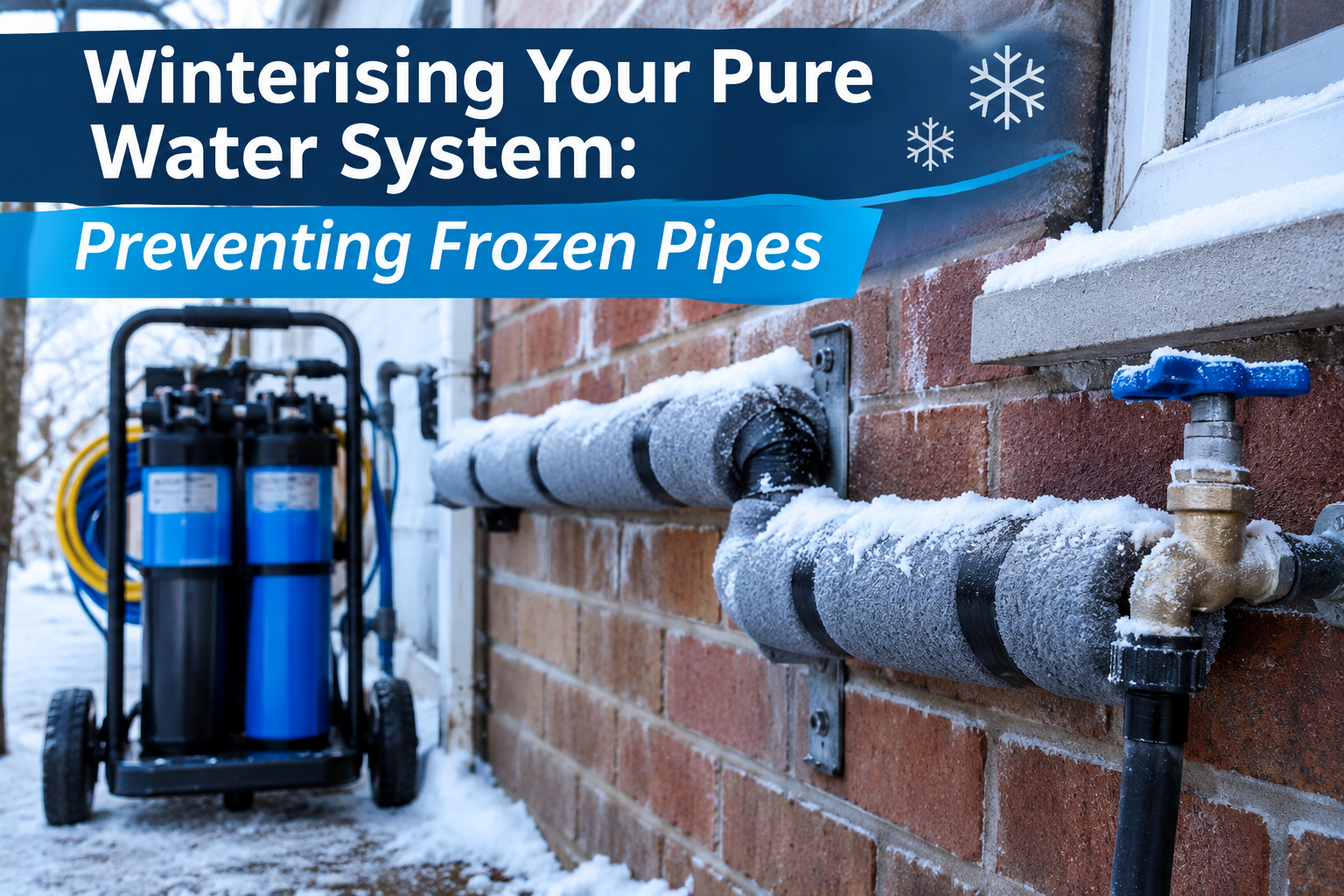
Winter can be unforgiving on professional window cleaning equipment. One frosty night is sometimes all it takes to leave you with frozen hoses, damaged filtration components, a struggling water pump or, worse, burst pipes that put your entire working day on hold.
Whether you're running a van-mounted reverse osmosis (RO) system, using deionisation (DI) resin vessels or storing purified water in an outbuilding, proper winter preparation is essential.
The good news? Protecting your equipment doesn't have to be complicated or expensive.
Here's what you need to know before temperatures drop:
-
Insulate vulnerable pipework and hoses. Foam pipe lagging, thermal sleeves and suitable tank insulation help slow heat loss and reduce the risk of freezing.
-
Protect your filtration equipment. RO membranes, filter housings and DI vessels can suffer damage when trapped water freezes and expands.
-
Pay attention to your storage location. Unheated garages, sheds and window cleaning vans can become dangerously cold overnight, even when daytime temperatures seem manageable.
-
Drain equipment that won't be used. Follow manufacturer-approved winter storage procedures, particularly for RO membranes that may require specific preservation methods.
-
Check pumps, fittings and connectors. Small amounts of trapped water can freeze inside vulnerable components, potentially causing cracks, leaks or mechanical damage.
-
Monitor overnight temperatures. Don't wait until your hoses are frozen solid before taking action.
-
Never force a frozen system to operate. Allow equipment to thaw safely and inspect it for damage before restarting.
The bottom line: A little preventative maintenance can save you from expensive repairs, lost working hours and unnecessary disruption to your window cleaning schedule.
For homeowners, understanding how professional equipment is protected during winter also provides useful insight into why reliable, properly maintained window cleaning services matter throughout the colder months.
Why Winterising Your Pure Water System Matters
Picture this.
It's 7 am on a bitter January morning. You've loaded the van, planned your route and have a full day of window cleaning appointments ahead.
You switch on your water-fed pole system.
Nothing.
The pump hums, but there's barely a trickle of water. Your hose feels unusually stiff, and the connectors won't budge.
Overnight frost has done its damage.
It's a frustrating situation, particularly when you've got customers expecting you. But it's also largely avoidable.
The Hidden Cost of Frozen Window Cleaning Equipment
When temperatures fall below freezing, water left inside pipes, pumps, filters and hoses can turn to ice. As it freezes, it expands by approximately 9%.
That expansion creates pressure, especially in enclosed spaces where the ice has nowhere to go.
The consequences can include:
-
Split pipes and damaged fittings: Frozen water can place enough pressure on vulnerable pipework, connectors and joints to cause cracks or leaks.
-
Damaged RO membranes: Freezing can compromise the delicate structure of reverse osmosis membranes, potentially affecting filtration performance and water quality.
-
Pump failure: Ice inside a pump head or associated pipework may damage seals, valves or other internal components.
-
Burst filter housings: Sediment filters, carbon filter housings and resin vessels may crack when trapped water expands.
-
Lost income: A frozen system can mean cancelled appointments, disrupted schedules and unexpected repair bills.
And here's the particularly frustrating part.
You might not realise anything is wrong until the equipment thaws.
A small crack in a filter housing or connector can remain hidden while frozen, only to start leaking once water begins flowing again.
That's why effective window cleaning system freeze protection involves more than simply checking whether your hoses have thawed.
It means protecting the entire water delivery system before frost arrives.
Why Winter Maintenance Matters for Your Customers Too
A reliable window cleaning service depends on properly maintained equipment.
Professional pure water cleaning systems allow window cleaners to wash glass, frames and sills using purified water delivered through specialist water-fed poles. When used correctly, the water dries without the mineral deposits commonly associated with ordinary tap water.
However, frozen equipment can interrupt this process.
For customers arranging window cleaning services across the UK, choosing a provider who understands seasonal maintenance can help reduce the likelihood of avoidable winter disruptions.
Cold weather doesn't automatically mean windows can't be cleaned. Conditions need to be assessed carefully, particularly where freezing water could create slippery surfaces or other hazards.
A professional should know when it's safe to work, when additional precautions are necessary and when postponing a visit is the sensible choice.
How Freezing Temperatures Damage Pure Water Equipment
To understand how to prevent frozen pure water pipes, it helps to know what actually happens inside the system when temperatures plummet.
Pure water systems contain several components that respond differently to cold weather.
A thick storage tank, for example, behaves differently from a narrow pole hose. Likewise, an RO membrane housing has different vulnerabilities from a water pump or DI resin vessel.
Understanding these differences makes winter preparation considerably more effective.
What Temperature Does a Pure Water System Freeze At?
Pure water freezes at approximately 0°C under normal atmospheric pressure.
In practice, the temperature at which individual parts of a window cleaning system begin to freeze depends on several factors:
-
The amount of water inside the component.
-
The diameter and material of the pipe or hose.
-
Whether the equipment is exposed to moving air.
-
The surrounding temperature and duration of exposure.
-
The level of insulation surrounding the equipment.
-
Whether the system is stored inside a heated building, garage or vehicle.
A narrow microbore hose containing a small volume of water may freeze much sooner than a large storage tank.
Similarly, exposed connectors and short sections of external pipework can become vulnerable before the main tank shows any visible signs of ice.
Important: Insulation slows the rate at which equipment loses heat. It doesn't generate heat or guarantee protection during prolonged sub-zero conditions.
If temperatures remain below freezing for long enough, even well-insulated equipment can eventually freeze unless an appropriate heat source or other protective measure is used.
The Freeze-Thaw Cycle: Why Damage Isn't Always Immediate
Freezing is only half the problem.
The thawing process can reveal damage that wasn't immediately obvious.
Consider what happens during a typical British winter cold snap:
-
Overnight temperatures fall. Water inside an exposed hose, filter housing or pump begins to freeze.
-
Ice expands. Pressure builds within confined sections of the system, potentially damaging fittings, seals or housings.
-
Daytime temperatures rise. The ice melts, allowing water to move through previously frozen components.
-
Leaks become apparent. Cracks and weakened joints may begin releasing water as normal pressure returns.
Repeated freeze-thaw cycles can place additional stress on vulnerable components.
This is particularly relevant for window cleaners who leave equipment in their vans overnight and use it again the following morning.
A system might survive one cold night without obvious problems, only to develop a leak after repeated exposure.
Winter maintenance tip: Don't assume your pure water system is undamaged simply because water starts flowing again. After a freeze, inspect hoses, connectors, pump heads and filter housings carefully before returning the equipment to normal operating pressure.
Can Freezing Damage a Reverse Osmosis Membrane?
Yes. And for professional window cleaners, this is one of the most important risks to understand.
Reverse osmosis membranes are designed to separate dissolved minerals and other impurities from water under controlled operating conditions.
They're not designed to withstand ice forming inside their delicate internal structure.
If water trapped within an RO membrane freezes, expansion can damage the membrane material or its internal construction.
Possible consequences include:
-
Reduced filtration efficiency.
-
Increased total dissolved solids (TDS) readings.
-
Changes in water production performance.
-
Internal damage that isn't visible from outside the housing.
-
The need for membrane replacement.
An RO membrane may look perfectly normal after thawing while no longer performing as expected.
This is why RO membrane freeze protection should be a priority whenever a filtration system is stored in an unheated environment.
Don't assume that draining the external pipes automatically removes all water from the membrane itself.
Some membranes must remain properly hydrated during storage, and manufacturers may specify particular preservation procedures.
Always follow the guidance for your individual filtration system rather than attempting to dry or drain the membrane indiscriminately.
Can DI Resin Freeze in Cold Weather?
DI resin vessels are another important consideration.
Deionisation resin is commonly used to remove remaining dissolved ions from water, either as part of an RO/DI system or in a standalone filtration setup.
Although the resin itself isn't a conventional pipe or mechanical component, the water contained within the vessel can still freeze.
That creates several potential problems.
The resin bed may be affected by freezing conditions, while expanding ice can place pressure on the vessel, internal distributors and connected fittings.
The exact risk depends on the resin type, vessel design, water content and manufacturer's storage recommendations.
The safest approach is to protect DI vessels from freezing altogether.
Where possible, store portable vessels in a frost-free environment and avoid leaving water-filled housings exposed to overnight frost.
Insulating Your Pure Water Pipes, Hoses and Storage Tanks
Now for the practical side.
One of the most effective starting points for winterising a pure water system is identifying where heat escapes and protecting those areas before the first serious frost.
You don't necessarily need to overhaul your entire setup.
Often, it's the smaller, easily overlooked components that need attention first.
1. Identify the Most Vulnerable Parts of Your System
Before buying insulation, inspect your equipment from the water supply connection right through to the water-fed pole.
Pay particular attention to:
| Component | Why it's vulnerable | Recommended protection |
|---|---|---|
| Exposed water pipes | Direct exposure to freezing air | Suitable foam pipe lagging |
| Microbore and minibore hoses | Small water volume and narrow internal diameter | Drain where practical and store frost-free |
| Hose reels | Water can remain trapped inside wound hoses | Drain and protect from freezing |
| Water storage tanks | Prolonged cold can eventually freeze stored water | Suitable tank insulation and frost-free storage |
| Pump heads | Trapped water can damage internal components | Follow manufacturer-approved draining and storage procedures |
| RO filter housings | Water expansion can crack housings | Keep filtration units above freezing |
| DI resin vessels | Trapped water can freeze within the vessel | Store in a frost-free location |
| Connectors and valves | Small internal cavities can retain water | Drain, insulate or remove for protected storage |
Don't forget the fittings beneath your tank or behind your filtration unit.
These areas are easily missed during routine inspections, yet they may be among the first to suffer frost damage.
2. Use Suitable Pipe Lagging
Pipe lagging is a straightforward way to reduce heat loss from exposed pipework.
Foam insulation sleeves are commonly used for domestic plumbing, and appropriately sized products can also be useful for certain fixed sections of pure water equipment.
When choosing insulation, consider:
-
Pipe diameter: The insulation should fit securely without leaving large gaps.
-
Material suitability: Choose insulation appropriate for the pipe material and its operating environment.
-
Moisture resistance: Equipment stored in vans and outbuildings may be exposed to condensation or damp conditions.
-
Installation access: Valves, connectors and maintenance points should remain accessible.
-
Insulation thickness: Greater thermal resistance can slow heat loss, although it cannot prevent freezing indefinitely.
For fixed pipework, fit insulation neatly around bends and joints, securing it according to the manufacturer's instructions.
Avoid leaving exposed gaps around connectors and valves wherever practical.
However, don't wrap electrical components, pump ventilation openings or equipment that requires airflow unless the manufacturer specifically permits it.
3. Protect Your Pure Water Storage Tank
A van-mounted tank can hold hundreds of litres of purified water.
That large volume generally takes longer to cool than the small amount of water trapped in a hose or connector, but it isn't immune to freezing.
During prolonged cold weather, ice may begin forming near the tank walls or other exposed areas.
Appropriate water tank insulation can help reduce heat loss, particularly when combined with a suitable frost-free storage environment.
For van-mounted systems, consider the following precautions:
-
Check whether the tank manufacturer recommends a particular insulation material or protective cover.
-
Inspect the tank outlet, fittings and nearby pipework, which may be more vulnerable than the main water volume.
-
Keep insulation clear of electrical equipment and components requiring ventilation.
-
Monitor temperatures inside the vehicle rather than relying solely on outdoor weather forecasts.
-
Where necessary, use a professionally installed, appropriately rated frost-protection solution suitable for the vehicle and equipment.
Never use an unattended portable fuel-burning heater inside a van or enclosed outbuilding. Fire, ventilation and carbon monoxide risks make improvised heating arrangements particularly dangerous.
Remember: Protecting the tank alone isn't enough. A perfectly usable tank of water won't help if the outlet fitting or delivery hose is frozen solid.
Protecting RO Membranes and DI Resin During Winter
Your reverse osmosis membrane is one of the most important components in your pure water filtration system. It's also one of the components you really don't want to replace unnecessarily.
While a frozen hose might recover after careful thawing, damage to an RO membrane can be permanent.
And the frustrating thing? You might not even notice the damage until your water quality starts deteriorating.
How to Protect an RO System in Winter
Reverse osmosis systems contain several components that need protecting from freezing temperatures, including membrane housings, sediment filters, carbon filters, pressure gauges and connecting pipework.
A sensible winter protection routine begins with understanding where your equipment is stored.
If your RO system is installed in a garage or outbuilding:
-
Check whether the building remains above freezing overnight.
-
Insulate exposed water supply pipes using suitable pipe lagging.
-
Protect the filtration unit from cold draughts and direct exposure to outside air.
-
Consider a properly installed thermostatically controlled frost-protection heater where suitable.
-
Monitor temperatures near the filtration equipment, particularly during prolonged cold snaps.
An unheated garage might feel reasonably sheltered, but that doesn't necessarily make it frost-free.
During extended periods of sub-zero weather, temperatures inside poorly insulated buildings can eventually approach those outdoors.
If your RO system is installed inside a window cleaning van:
The risks can be even greater.
Vehicles lose heat quickly when parked overnight, and exposed fittings, filter housings and pipework may freeze before the main storage tank.
Where practical, portable filtration equipment should be moved into a suitable frost-free storage area.
For permanently installed systems, consider a professionally designed cold weather protection arrangement that accounts for ventilation, electrical safety and the manufacturer's operating requirements.
Important: Never assume that wrapping an RO membrane housing in insulation will provide complete frost protection. Insulation slows heat loss, but it cannot maintain a safe temperature indefinitely without a suitable heat source.
Should You Drain Your Reverse Osmosis Membrane for Winter?
This is where many window cleaners make a potentially expensive mistake.
It might seem logical to drain every drop of water from your RO system before storing it.
After all, no water means no ice, right?
Unfortunately, reverse osmosis membranes aren't always that straightforward.
Many RO membranes must remain properly hydrated during storage. Allowing certain membrane materials to dry out can affect their performance.
For this reason, draining an RO system and preserving its membrane are not necessarily the same process.
Before shutting down your filtration equipment for an extended period:
-
Consult the manufacturer's winter storage instructions.
-
Determine whether the membrane requires wet storage or an approved preservation procedure.
-
Check whether the system has designated drain points or removable components.
-
Follow the recommended flushing or preservation process, where applicable.
-
Store the membrane and housing under the specified temperature conditions.
Don't introduce automotive antifreeze or household chemicals into a pure water filtration system.
Some membrane manufacturers specify particular preservation solutions for certain applications, but these must be compatible with the membrane and used strictly according to the manufacturer's instructions.
The safest general rule is simple: keep RO membranes above freezing and follow the correct storage procedure for your equipment.
Protecting DI Resin Vessels from Frost
Deionisation vessels are often overlooked during winter preparation.
They're relatively simple pieces of equipment, which can create the impression that they're less vulnerable than pumps or reverse osmosis units.
However, a DI vessel containing water can still suffer frost-related damage.
The vessel body, internal fittings and connectors may all be affected if trapped water freezes.
For portable DI vessels, the most straightforward precaution is to store them in a frost-free location.
For permanently mounted systems, inspect the surrounding pipework and consider whether the vessel can be protected adequately in its existing position.
Pay particular attention to:
-
Inlet and outlet connectors.
-
Vessel heads and seals.
-
Internal distributor components.
-
Exposed fittings beneath the vessel.
-
Water-filled connecting hoses.
Don't assume that a resin vessel is safe simply because it contains less water than your main storage tank.
Small components can freeze relatively quickly when exposed to cold air.
Checking Water Quality After a Freeze
If your filtration equipment has been exposed to freezing conditions, checking the quality of the water it produces is an important part of restarting the system.
A total dissolved solids meter, commonly called a TDS meter, measures the concentration of dissolved ions in water.
Professional window cleaners often use these readings to assess whether their purification system is producing water suitable for spot-free cleaning.
After your system has thawed completely and passed a visual inspection:
-
Check filter housings, connectors and pipework for visible cracks or leaks.
-
Follow the manufacturer's recommended restart procedure.
-
Allow the system to operate under appropriate conditions.
-
Measure the TDS of the water produced by the RO stage, where a suitable sampling point is available.
-
Compare the reading with previous operating records.
-
Check the final purified water TDS before using it for window cleaning.
A sudden deterioration in RO performance could indicate membrane damage, although changes in feedwater quality, temperature, pressure and other operating conditions can also affect readings.
If you suspect freeze damage, stop using the equipment and seek advice from the system manufacturer or a qualified technician.
A normal TDS reading alone doesn't prove that every component is undamaged.
Winterising Your Van-Mounted Pure Water System
For many professional window cleaners, the van is effectively a mobile workshop.
It carries the storage tank, filtration equipment, pumps, hose reels and water-fed poles needed to complete daily appointments.
Unfortunately, it's also one of the most challenging environments in which to protect water-filled equipment during winter.
A van parked outside overnight can become extremely cold, particularly when exposed to wind and prolonged frost.
And while the main tank may take some time to freeze, the smaller components connected to it can become vulnerable much sooner.
Protecting Your Window Cleaning Van from Frost
Start by considering where your van spends the night.
A sheltered parking position may reduce exposure to wind, but it doesn't guarantee that the equipment inside will remain above freezing.
If you have access to a suitable frost-free garage, this may provide a more reliable storage environment.
Where that isn't possible, additional precautions become important.
Practical steps include:
-
Monitoring the temperature inside the van overnight.
-
Insulating vulnerable fixed pipework and tank connections.
-
Protecting filtration equipment from freezing.
-
Removing portable components for indoor storage where practical.
-
Draining hoses and equipment where recommended.
-
Inspecting connectors, valves and pumps before starting work.
A temperature monitor with minimum and maximum readings can be particularly useful.
It allows you to see how cold the vehicle became overnight, rather than guessing based on the temperature when you arrive in the morning.
For more advanced setups, a temperature alarm can provide an early warning when conditions approach freezing.
However, monitoring temperatures is only useful if you have a practical plan for responding when they become unsafe.
Insulating a Van-Mounted Water Tank
Pure water storage tank insulation can help reduce the rate at which stored water loses heat.
Suitable insulation may include purpose-designed tank jackets or other materials approved for the installation.
However, insulation must never interfere with the tank's mounting arrangements, access points or safety requirements.
Remember that a full tank is extremely heavy.
Any modifications to a van-mounted installation must preserve the integrity of its restraints and the vehicle's safe load distribution.
When considering insulation, pay attention to the tank's surroundings as well as the tank itself.
For example, the water outlet beneath a tank may be exposed to colder air than the bulk of the stored water.
That small outlet can freeze even when the main tank remains largely unfrozen.
This is why insulating only the tank walls may not solve the problem.
A more complete approach considers the tank, outlet fittings, delivery pipes, pump and associated connectors together.
Protecting Your Water Pump from Freezing
Your pump is responsible for delivering purified water from the storage tank to your water-fed pole.
If water freezes inside the pump head, it can potentially damage internal components.
Depending on the pump design, these may include:
-
Diaphragms.
-
Valves.
-
Seals.
-
Pump head housings.
-
Connecting fittings.
Even a small amount of trapped water can create problems if it freezes inside a confined space.
For effective pure water pump freeze protection, follow the manufacturer's shutdown and winter storage recommendations.
Some systems allow water to be drained or purged from designated sections. Others may require particular procedures to protect seals or internal components.
Avoid running a pump dry unless the manufacturer specifically permits it.
Likewise, never switch on a pump when you suspect the system is frozen.
Doing so can place unnecessary strain on the equipment and may worsen existing damage.
Before restarting after a cold night, check that the pump, inlet pipework and delivery hoses are completely free from ice.
If anything appears frozen, allow it to thaw safely before attempting to operate the system.
Preventing Frozen Hose Reels
Hose reels are particularly vulnerable during winter.
Why?
Because they contain long lengths of relatively narrow hose, often with water remaining inside after the working day.
Microbore and minibore hoses can freeze quickly when exposed to sub-zero temperatures.
Once frozen, the hose may become stiff and difficult to unwind.
Attempting to force it can damage the hose, connectors or reel mechanism.
To reduce the risk:
-
Drain residual water from the hose where practical and permitted by the system manufacturer.
-
Avoid leaving water-filled hose sections exposed outside overnight.
-
Store removable hose reels in a suitable frost-free environment.
-
Inspect quick-release connectors and hose fittings for trapped water.
-
Check the hose for stiffness or visible ice before unwinding it.
Don't assume that a hose is empty simply because water has stopped flowing from the end.
Low points, coils and bends can retain pockets of water.
For window cleaners using long hose reels, preventing frozen hoses should be a regular part of the end-of-day routine throughout winter.
Protecting Water-Fed Poles and Pole Hoses
Water-fed pole systems also need attention.
The narrow hose running through a telescopic pole can retain small quantities of water, particularly around connectors and brush fittings.
If this freezes, it may restrict water flow or place stress on vulnerable components.
Before storing your pole:
-
Disconnect it according to the manufacturer's instructions.
-
Drain residual water where practical.
-
Inspect the brush head and jets.
-
Check hose connectors for trapped moisture.
-
Store the equipment somewhere protected from freezing temperatures.
Avoid forcing frozen telescopic sections apart.
Likewise, don't bend or sharply flex a hose that has become rigid with ice.
Allow the equipment to thaw naturally in a suitable environment before handling it normally.
Draining and Storing Your Pure Water System Safely
Not every window cleaner works throughout the winter.
Some reduce their workload during the coldest weeks, while others temporarily stop using particular filtration systems.
If your equipment will be unused for several days or weeks, proper storage becomes especially important.
The objective is to prevent trapped water from freezing without damaging components that require specific storage conditions.
How to Drain a Window Cleaning System for Winter
Before draining any part of your setup, identify which components can safely be emptied and which require specialist preservation.
A typical preparation routine might include the following steps.
Step 1: Switch off the system
Turn off pumps and associated electrical equipment using the manufacturer's recommended shutdown procedure.
Isolate the incoming water supply where appropriate.
Step 2: Release pressure safely
Follow the system instructions for depressurising pipework and filter housings before disconnecting components.
Never loosen pressurised fittings.
Step 3: Drain designated pipework
Open manufacturer-provided drain points where available.
Pay particular attention to low sections of pipework where water may collect.
Step 4: Empty suitable hoses
Drain removable hoses and pole hoses where practical, avoiding excessive bending or force.
Step 5: Protect filtration components
Follow the specific storage requirements for RO membranes, DI resin vessels and filter housings.
Do not assume that every component should be drained completely.
Step 6: Check pumps and connectors
Inspect vulnerable fittings and follow the pump manufacturer's winterisation instructions.
Step 7: Store equipment appropriately
Move portable equipment into a frost-free location where possible.
If the main installation must remain in a van or outbuilding, ensure the storage conditions are suitable for the equipment.
Don't Forget Your Water Supply and Stop Tap
If your pure water production system is connected to a domestic or commercial water supply, the incoming plumbing also needs consideration.
Exposed supply pipes, outdoor taps and pipework running through unheated garages or outbuildings can freeze during cold weather.
Knowing where your stop tap or stopcock is located can make a considerable difference if a pipe bursts.
If you discover a leak, being able to isolate the water supply quickly may help limit water damage.
The general principles recommended by organisations such as WaterSafe include protecting vulnerable pipework, insulating exposed sections and knowing how to shut off the water supply.
For fixed plumbing installations, use suitable insulation and seek professional advice where necessary.
Never attempt to modify mains plumbing unless you're competent and authorised to carry out the work.
Choosing the Right Winter Storage Location
Where you store your equipment can be just as important as how you prepare it.
Consider the differences between common storage environments:
| Storage location | Main consideration | Recommended approach |
|---|---|---|
| Heated indoor storage | Generally lower freezing risk | Maintain suitable temperatures and follow equipment storage instructions |
| Frost-free garage | Useful for larger portable systems | Confirm that temperatures remain above freezing |
| Unheated garage | May reach freezing temperatures | Monitor conditions and provide suitable frost protection |
| Garden shed | Often poorly insulated | Avoid storing water-filled equipment without reliable frost protection |
| Window cleaning van | Temperature can fall rapidly overnight | Protect vulnerable components and monitor internal temperatures |
| Outdoor storage | Direct exposure to frost and weather | Avoid for vulnerable water-filled equipment wherever possible |
Remember that a building doesn't need to feel particularly cold for equipment to be at risk.
A garage that remains above freezing during the afternoon may become much colder overnight.
And a short spell of sunshine the following morning doesn't necessarily mean every component has thawed.
Preparing Your Equipment for an Extended Winter Shutdown
If you're putting your system away for several weeks, it's worth being thorough.
A rushed shutdown can leave small quantities of water trapped in places you wouldn't normally think to check.
Before leaving equipment unused for an extended period, confirm that:
-
All designated drain points have been addressed.
-
RO membranes have been preserved according to manufacturer guidance.
-
Portable DI vessels are stored appropriately.
-
Pumps and filter housings are protected against freezing.
-
Hoses and connectors have been inspected.
-
Electrical equipment has been shut down safely.
-
Storage temperatures are suitable for the equipment.
Keep a record of any maintenance completed and note components that may require attention before the system is restarted.
It's a small administrative task, but one that can save considerable time when the warmer weather returns.
A well-prepared system should be easier to inspect, test and return to service without unexpected leaks or avoidable filtration problems.
What to Do If Your Pure Water System Freezes
Even with the best preparation, winter weather can catch you off guard.
Perhaps temperatures dropped further than forecast. Maybe an exposed connector escaped your attention. Or perhaps your window cleaning van spent an unexpectedly cold night outside.
Whatever the reason, discovering frozen equipment first thing in the morning is never welcome.
But what you do next matters.
Trying to force water through a frozen system can turn a manageable problem into an expensive repair.
The priority is to identify the affected components, allow them to thaw safely and check for damage before restarting.
How to Tell If Your Pure Water System Is Frozen
Not every loss of water pressure is caused by ice.
Blocked filters, pump faults, kinked hoses and electrical problems can produce similar symptoms.
However, freezing becomes a strong possibility when equipment has been exposed to sub-zero temperatures.
Common warning signs include:
-
Little or no water reaching your water-fed pole.
-
Hoses that feel unusually stiff or rigid.
-
Ice visible around connectors, valves or brush jets.
-
Reduced water flow despite an apparently adequate tank level.
-
A pump that struggles to deliver water.
-
Frozen or difficult-to-operate fittings.
-
Unexpected leaks appearing as temperatures rise.
If you notice any of these symptoms after a particularly cold night, don't immediately assume that your pump has failed.
Start by checking whether the system has been exposed to freezing conditions.
How to Thaw Frozen Window Cleaning Hoses Safely
Frozen hoses can be frustrating, especially when you've got a busy schedule ahead.
The temptation is to get them thawed as quickly as possible.
However, excessive heat or rough handling can cause further damage.
Follow these steps instead:
-
Switch off the pump. Don't attempt to force water through a blocked or frozen hose.
-
Move the hose somewhere warmer. If practical, bring removable hoses or hose reels into a frost-free indoor environment.
-
Allow gradual thawing. Gentle ambient warmth is generally safer than applying concentrated heat.
-
Avoid sharp bends. Frozen hoses may be less flexible and more vulnerable to damage.
-
Inspect the full length. Once thawed, check for splits, deformation and damaged connectors.
-
Test carefully. Reconnect the hose only after confirming that it is fully thawed and appears undamaged.
Never use a naked flame, blowtorch or uncontrolled high-temperature heat source to thaw hoses or pipework.
Avoid pouring boiling water directly onto plastic fittings, filter housings or other vulnerable components.
Sudden temperature changes can damage materials, while uncontrolled heating introduces unnecessary safety risks.
Professional tip: If your hose has frozen repeatedly, don't just focus on thawing it each morning. Review how it is drained, stored and protected overnight. Preventing the problem is considerably better than dealing with it every working day.
What Happens If Your Pure Water Pump Freezes?
A frozen pump requires particular care.
If water has turned to ice inside the pump head, internal components may be under stress.
Attempting to operate the pump before it has thawed can worsen existing damage.
If you suspect your pump is frozen:
-
Turn off its electrical supply.
-
Check for visible ice around the pump head and connecting fittings.
-
Allow the pump to thaw naturally in a suitable frost-free environment.
-
Inspect accessible components for cracks, leaks or deformation.
-
Follow the manufacturer's restart procedure.
-
Stop immediately if you notice unusual noises, leaks or abnormal operation.
Don't dismantle pressurised equipment or attempt repairs beyond your competence.
If the pump has suffered visible damage, arrange an appropriate inspection or replacement before returning it to service.
Checking for Burst Pipes and Hidden Leaks
One of the biggest risks following a freeze is discovering that a pipe or fitting has split.
Sometimes the damage is obvious.
Water may begin leaking from a connector as soon as the ice melts.
Other times, the problem is more subtle.
A small crack might only become apparent when the system returns to its normal operating pressure.
Before restarting, inspect:
-
Pipe joints and compression fittings.
-
Push-fit connectors.
-
Filter housings.
-
Tank outlets.
-
Pump heads and seals.
-
Hose reel connections.
-
Shut-off valves.
-
RO membrane housings.
If your equipment is connected to a mains water supply and you discover a significant leak, isolate the supply using the appropriate stop tap or shut-off valve.
For general guidance on preventing and responding to frozen domestic pipework, British Gas provides advice on protecting pipes during cold weather.
Once the system has thawed, any testing should follow the equipment manufacturer's procedures.
Never attempt to pressurise equipment with visible cracks or suspected structural damage.
When Should You Replace a Frozen Component?
Not every component exposed to frost needs replacing.
However, some types of damage make replacement the safest option.
For example, a cracked plastic filter housing should not be returned to service simply because it appears to hold water at low pressure.
Similarly, a damaged hose connector may fail unexpectedly during normal operation.
Consider professional inspection or replacement where you discover:
-
Cracked filter housings or resin vessels.
-
Split pipes or damaged connectors.
-
Leaking pump heads.
-
Deformed fittings.
-
Persistent water leaks.
-
Significant deterioration in RO membrane performance.
-
Components that no longer operate according to their specifications.
When in doubt, contact the equipment manufacturer or a suitably qualified technician.
A replacement fitting may cost relatively little compared with the consequences of a serious leak or an unexpected equipment failure.
Your Essential Pure Water System Winter Maintenance Checklist
The easiest way to prevent frozen pipes is to make cold weather protection part of your regular working routine.
You don't need to spend hours inspecting every component each evening.
A few consistent checks can make a substantial difference.
Before the First Frost
Complete these preparations before winter temperatures become a regular concern.
- Inspect exposed pipework for damage or deterioration.
- Fit suitable pipe lagging to vulnerable fixed pipes.
- Check tank outlets, valves and connectors.
- Review RO membrane and DI resin storage requirements.
- Inspect pump heads and associated fittings.
- Identify suitable frost-free storage for portable equipment.
- Check that hose reels and pole hoses can be drained appropriately.
- Install a suitable temperature monitor where useful.
- Locate the water supply stop tap.
- Review the manufacturer's winterisation instructions.
At the End of Each Working Day
During periods when overnight frost is possible:
- Check the latest overnight temperature forecast.
- Switch off equipment according to the manufacturer's instructions.
- Drain designated hoses and pipework where practical.
- Protect removable fittings and portable filtration equipment.
- Store water-fed poles and hoses appropriately.
- Check that tank outlets and exposed connectors are protected.
- Confirm that any installed frost-protection equipment is operating safely.
- Ensure the van or storage area is secure.
Before Starting Work on a Cold Morning
- Check the overnight minimum temperature.
- Inspect exposed hoses and connectors for ice.
- Confirm that the pump and associated pipework are not frozen.
- Check filtration housings for visible damage.
- Inspect the tank outlet and water delivery connections.
- Restart the system using the recommended procedure.
- Check for leaks and abnormal pump operation.
- Measure final water TDS where appropriate.
- Assess outdoor working conditions before beginning.
Keep this checklist accessible in your van or equipment storage area.
Consistency matters more than complexity.
A simple routine carried out every day is far more useful than an elaborate winter maintenance plan that never gets followed.
Keeping Window Cleaning Work Safe During Winter
Protecting equipment is only one part of working successfully through the colder months.
Professional window cleaners also need to consider the conditions around the property.
Water that runs harmlessly across a path in summer can become a serious slipping hazard when temperatures fall below freezing.
Likewise, icy surfaces, poor visibility and strong winds can make certain jobs unsuitable.
When Is It Too Cold to Clean Windows?
There isn't one universal outdoor temperature at which every window cleaning job becomes unsafe.
Conditions depend on several factors, including:
-
Whether water is freezing on contact with surfaces.
-
The temperature of glass, frames and surrounding materials.
-
The condition of paths, driveways and entrances.
-
Wind chill and exposure.
-
The type of equipment being used.
-
The likelihood of runoff creating ice.
-
The operator's ability to work safely.
Even when the air temperature rises slightly above freezing, shaded surfaces may remain icy.
This is particularly important around north-facing elevations, sheltered paths and areas that receive little winter sunlight.
If cleaning could create hazardous ice or conditions are otherwise unsafe, the sensible decision is to postpone the work.
Why Reliable Winter Window Cleaning Matters
Windows don't stop collecting dirt simply because the weather gets colder.
Rain, airborne pollution, road spray and general environmental debris can continue accumulating throughout winter.
For homeowners and businesses, maintaining clean windows can help preserve the appearance of a property year-round.
However, reliability matters just as much as appearance.
A professional window cleaner should maintain equipment properly, assess weather conditions and communicate clearly when appointments need to change.
At Pivotal Window Cleaning, our focus is on helping people across the UK connect with window cleaning services.
Understanding the challenges that professional cleaners face during winter helps customers appreciate why safe working practices and properly maintained equipment are important.
Common Winterisation Mistakes to Avoid
Sometimes it's the smallest oversights that cause the biggest problems.
Here are several mistakes worth avoiding.
Assuming a Garage Is Always Frost-Free
An unheated garage may provide shelter from rain and wind, but it can still become cold enough for water-filled equipment to freeze.
Monitor the actual temperature rather than relying on assumptions.
Insulating the Tank but Ignoring the Connectors
A large storage tank may remain unfrozen while the smaller fittings connected to it become blocked with ice.
Protect the complete water delivery system, not just its largest component.
Running a Pump to Clear Frozen Pipes
A pump isn't a defrosting device.
Operating it against an ice blockage can cause additional mechanical stress or damage.
Thaw the affected components safely before restarting.
Draining RO Membranes Incorrectly
Some RO membranes require wet storage or specific preservation procedures.
Improperly drying or storing them can damage their performance.
Always follow manufacturer guidance.
Using Inappropriate Heating Equipment
Improvised heating arrangements can create fire, electrical and carbon monoxide hazards.
Only use heating equipment suitable for the location, installed and operated according to applicable safety requirements.
Ignoring Small Leaks After Thawing
A minor drip can indicate a damaged connector, seal or housing.
Investigate the cause before returning the system to normal use.
Waiting Until the First Hard Frost
Winter preparation is much easier when your hoses are flexible, your fittings are accessible and your equipment isn't already frozen.
Ideally, complete your initial checks before overnight temperatures regularly approach 0°C.
Frequently Asked Questions About Winterising Pure Water Systems
Can a pure water system freeze overnight?
Yes. Water inside hoses, pumps, filter housings and connectors can freeze during a single cold night if temperatures fall sufficiently low.
Small-volume components may freeze sooner than larger storage tanks, particularly when exposed to cold air.
The risk depends on temperature, exposure, insulation and how long the equipment remains cold.
What is the best way to stop pure water pipes freezing?
The most reliable approach is to keep vulnerable water-filled equipment in a suitable frost-free environment.
Pipe insulation can help slow heat loss, while draining designated sections reduces the amount of water available to freeze.
For fixed installations, suitable temperature-controlled frost protection may also be necessary.
Can reverse osmosis membranes freeze?
Yes. RO membranes can be damaged if water trapped within them freezes.
Ice expansion may affect membrane integrity and filtration performance.
Protect membranes from freezing and follow the manufacturer's instructions for winter storage and preservation.
Should I drain my entire pure water system during winter?
Not necessarily.
Some components can be drained safely, but others, particularly certain RO membranes, require specific storage conditions.
Follow the manufacturer's instructions for each part of your system.
Avoid assuming that completely emptying every component is always the correct approach.
Can DI resin be damaged by freezing?
Freezing can create risks for water-filled DI resin vessels and their internal components.
The precise effects depend on the resin, vessel construction and storage conditions.
Keeping DI equipment in a frost-free environment is the safest general precaution.
How do I stop my window cleaning van water tank from freezing?
Where possible, park the vehicle in a suitable frost-free location.
Insulate vulnerable tank connections, monitor internal temperatures and protect pumps, filters and pipework.
For installations exposed to prolonged sub-zero conditions, a professionally designed frost-protection arrangement may be necessary.
Remember that insulation alone doesn't generate heat.
Is it safe to use hot water to thaw frozen window cleaning hoses?
Avoid using boiling water or uncontrolled high-temperature heat.
Excessive heat can damage certain hoses, connectors and plastic components.
A safer general approach is to move removable equipment into a frost-free environment and allow it to thaw gradually.
How do I know whether my RO membrane has been damaged by frost?
Possible warning signs include changes in water production and unexpectedly high TDS readings after the system has thawed.
However, these symptoms can have other causes.
Inspect the equipment, follow the manufacturer's testing procedure and compare performance against previous readings.
Seek specialist advice if damage is suspected.
Can I leave my water-fed pole outside during winter?
Leaving a water-fed pole outside in freezing conditions isn't advisable if water remains trapped in its hose, connectors or brush jets.
Drain the equipment where practical and store it somewhere protected from frost.
Avoid forcing frozen telescopic sections or bending rigid hoses.
Do professional window cleaners work during winter?
Yes. Many professional window cleaners continue operating throughout winter when conditions allow.
However, work may need to be postponed when freezing water, icy surfaces, strong winds or other hazards make cleaning unsafe.
Maintaining equipment and assessing conditions carefully are important parts of providing a reliable service.
Final Thoughts: Protect Your Equipment Before the Temperature Drops
Winter doesn't have to bring your window cleaning business to a standstill.
But it does demand preparation.
Frozen pipes, damaged RO membranes, cracked filter housings and seized pumps can all create expensive interruptions, particularly when they occur during an already busy working week.
Fortunately, many of these risks can be reduced through sensible preventative maintenance.
Start with the basics.
Insulate vulnerable pipework. Protect your water tank connections. Keep filtration equipment above freezing. Drain hoses where appropriate. Monitor overnight temperatures.
And perhaps most importantly, follow the manufacturer's guidance for the equipment you actually use.
A little attention before the first frost can help protect your investment, reduce unnecessary downtime and keep your system ready for the next suitable working day.
For homeowners and businesses, the same principle applies when choosing a window cleaning provider: reliable service depends on good preparation, appropriate equipment and safe working practices.
Looking for professional window cleaning services in your area?
Whether you're arranging regular residential window cleaning or looking for help maintaining a commercial property, finding a suitable local provider is an important first step.
Request a window cleaning quote and take the next step towards keeping your windows clean throughout the year.
Because while winter weather can be unpredictable, looking after your property shouldn't have to be.